
The global fuel cell market is entering a period of accelerated commercialization as governments and industries invest in hydrogen infrastructure to decarbonize transportation and power generation. Fuel cells, which convert hydrogen or other fuels into electricity through electrochemical reactions, are increasingly viewed as a viable alternative to conventional combustion technologies.
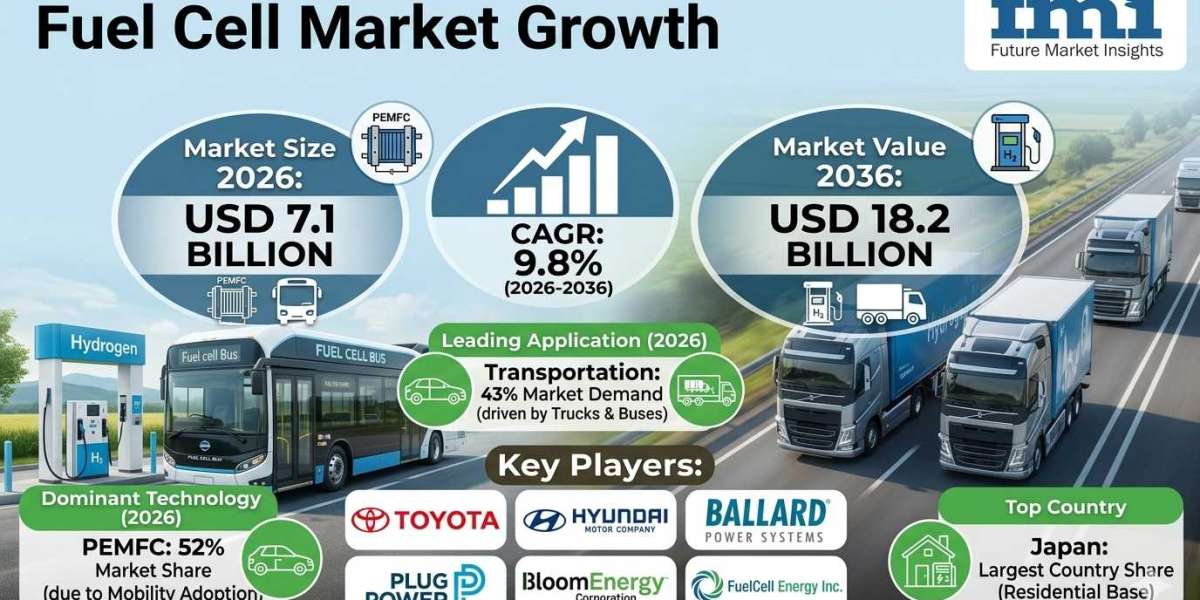
According to analysis by Future Market Insights (FMI), the fuel cell market is expected to grow from USD 7.1 billion in 2026 to USD 18.2 billion by 2036, registering a CAGR of 9.8% during the forecast period.
Key Takeaways
- The global fuel cell market is projected to reach USD 18.2 billion by 2036, expanding from USD 7.1 billion in 2026.
- The market is forecast to grow at a CAGR of 9.8% from 2026 to 2036.
- Proton Exchange Membrane Fuel Cells (PEMFC) dominate with 52% market share in 2026 due to strong adoption in mobility applications.
- Transportation applications account for 43% of market demand, driven by buses, trucks, and logistics fleets requiring rapid refueling.
- Japan maintains the largest country share due to its extensive residential fuel cell installation base.
Regional Analysis
Asia Pacific currently represents the largest market for fuel cells, supported by strong policy backing and hydrogen infrastructure development. Japan leads the global market with a significant installed base of residential fuel cell systems and continued government support for hydrogen technologies.
China is expected to record the fastest growth during the forecast period, driven by aggressive policy support for hydrogen-powered commercial vehicles and the rapid expansion of hydrogen refueling infrastructure. Government initiatives encouraging industrial-scale hydrogen production and fleet deployment are accelerating adoption.
South Korea is another major market benefiting from a national hydrogen economy roadmap that promotes fuel cell applications in both power generation and transportation sectors.
Report Coverage Deliverables
The FMI fuel cell market report provides a comprehensive assessment of global demand trends, market structure, and growth opportunities between 2026 and 2036.
The report analyzes the market across product types including PEMFC, SOFC, MCFC, PAFC, and DMFC technologies, along with key applications such as transportation, stationary power generation, and portable power systems.
Market Dynamics and Growth Prospects
The primary driver of the fuel cell market is the global shift toward hydrogen-based energy systems designed to reduce carbon emissions. Governments across major economies are investing in hydrogen production and distribution infrastructure, which lowers operational risks for fleet operators and industrial users adopting fuel cell technologies.
Heavy-duty transportation is emerging as a key growth segment because fuel cells offer advantages such as faster refueling, longer range, and improved operational efficiency compared with battery-electric systems in demanding duty cycles.
Request a free Sample Report – https://www.futuremarketinsights.com/reports/sample/rep-gb-65
Innovation and Emerging Technologies
Technological innovation is playing a critical role in improving fuel cell efficiency and reducing production costs. Advancements in catalyst materials, membrane durability, and system integration are enabling longer operating lifetimes and improved energy performance.
Manufacturers are also focusing on high-temperature fuel cell technologies such as solid oxide fuel cells (SOFC), which can deliver higher efficiency in stationary power applications.
Leading and Emerging Players Driving Competition
The global fuel cell market features a diverse mix of automotive manufacturers, energy technology companies, and specialized fuel cell developers. Major companies include Toyota Motor Corporation, Hyundai Motor Company, Ballard Power Systems, Plug Power Inc., Bloom Energy Corporation, and FuelCell Energy Inc.
These companies are investing heavily in research and development, strategic partnerships, and hydrogen infrastructure projects to strengthen their market position.
Future Outlook
The long-term outlook for the fuel cell market remains highly positive as hydrogen infrastructure continues to expand worldwide. Governments are expected to maintain strong policy support for hydrogen technologies as part of broader energy transition strategies.
Over the next decade, increasing investments in hydrogen production, transportation networks, and fueling infrastructure are expected to significantly reduce operational costs and improve the commercial viability of fuel cell systems.
Request Sample Report with Complete Market Breakdowns and Growth Estimates:
https://www.futuremarketinsights.com/reports/global-fuel-cell-market
Have a specific Requirements and Need Assistant on Report Pricing or Limited Budget please contact us – [email protected]
About Future Market Insights (FMI)
Future Market Insights, Inc. (FMI) is an ESOMAR-certified, ISO 9001:2015 market research and consulting organization, trusted by Fortune 500 clients and global enterprises. With operations in the U.S., UK, India, and Dubai, FMI provides data-backed insights and strategic intelligence across 30+ industries and 1200 markets worldwide.
Why Choose FMI: https://www.futuremarketinsights.com/why-fmi