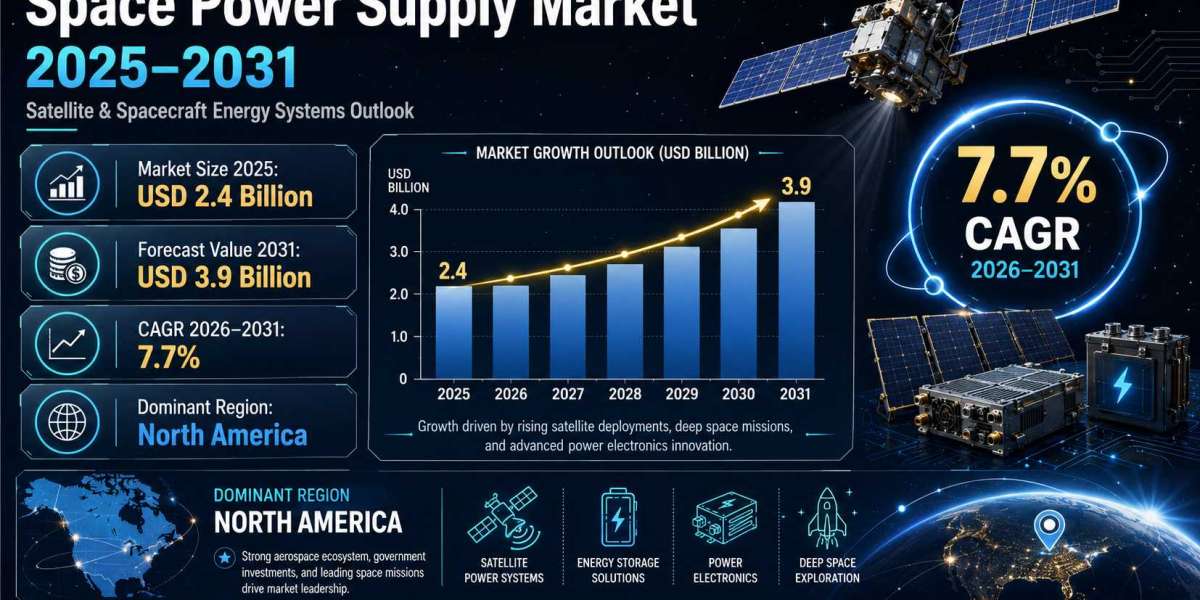

The Space Power Supply Market was valued at USD 2.4 billion in 2025 and is likely to reach USD 3.9 billion by 2031. The market is expected to grow at a CAGR of 7.7% during 2026–2031. “The Space Power Supply Market is expected to grow at a CAGR of 7.7% during 2026–2031.”
The growth trajectory is tied to spacecraft systems that require energy generation, storage, conditioning, distribution, and conversion. As mission duration and complexity increase, reliable power solutions become mission-critical. This Space Power Supply Market growth is supported by satellite launches, defense applications, space exploration programs, and sustainable satellite operations.
Request a free sample report:
https://www.stratviewresearch.com/Request-Sample/space-power-supply-market#form
Market Segmentation Analysis
The Space Power Supply Market is segmented by Product Type as Solar Panels Arrays, Batteries (Primary Batteries, Secondary Batteries, and Reserve Batteries), Power Modules, Thermoelectric Generators, and Other Products. Power modules are expected to remain dominant, while secondary batteries are likely to remain dominant among battery types in the coming years.
The Space Power Supply Market is segmented by Application Type as Launch Vehicles (Small Medium-Lift and Heavy Super-Heavy Lift), Satellites (LEO, MEO, and GEO), and Space Exploration (Rovers and Other Space Explorations). Satellites will continue to dominate, while launch vehicles are expected to be the fastest-growing segment.
Regional Market Insights
North America is expected to maintain its reign over the forecast period. The USA alone captured more than a two-thirds share of the total market. The region is likely to offer the highest growth opportunities, supported by increasing investments of startups and aggressive launch activities by SpaceX.
Asia-Pacific is expected to be the fastest-growing region. China, India, and Japan are key countries with a conspicuous share in the global market. The region’s ambitious programs are supporting stronger long-term demand within the space power supply industry.
Emerging Trends Shaping the Space Power Supply Market
The market outlook is shaped by improvements in solar cell efficiency, battery energy density, and nuclear-based systems. Thermoelectric generators are also relevant to space vehicles, particularly where higher specific energy is required. These trends indicate continued focus on power durability, efficiency, and mission suitability.
Key Growth Drivers of the Market
- Increasing mission complexity is making highly reliable power systems essential for spacecraft operations.
- Expanding low-Earth orbit constellations are boosting demand for solar arrays, batteries, and power modules.
- Defense applications are strengthening the need for durable power technologies across space platforms.
- Space exploration programs are increasing demand for long-duration energy solutions.
- Sustainable satellite operations are creating demand for efficient and dependable power supply architectures.
Competitive Landscape
Top Companies in the Market
Solaero Technologies, Inc.
Northrup Grumman Corporation
Spectrolab
Airbus
Sierra Nevada Corporation
Saft Groupe SA
Eaglepicher Technologies
AZUR Space Solar Power GmbH
Teledyne Technologies
Aerojet Rocketdyne
Airborne
Conclusion and Strategic Outlook
The Space Power Supply Market is forecast to reach USD 3.9 billion by 2031, growing at a CAGR of 7.7%. Its strategic growth trends are supported by satellites, launch vehicles, defense missions, and exploration needs. Power systems will remain central to spacecraft reliability as missions become longer and more technically demanding.
FAQs – Space Power Supply Market
What is the forecast value of the Space Power Supply Market?
The Space Power Supply Market is likely to reach USD 3.9 billion by 2031. It was valued at USD 2.4 billion in 2025.
What CAGR is projected for the Space Power Supply Market?
The Space Power Supply Market is expected to grow at a CAGR of 7.7% during 2026–2031. This growth reflects strong demand across satellites, launch vehicles, and exploration applications.
What are the main growth drivers?
Growth is driven by small satellites, reusable launch systems, and rising government and commercial space missions. Improvements in solar cells, battery energy density, and nuclear-based systems are also supporting demand.
Which region offers strong growth opportunities?
North America is expected to remain dominant and offer high growth opportunities. Asia-Pacific is expected to be the fastest-growing region during the forecast period.
What should investors monitor in this market?
Investors should monitor satellite launch activity, launch vehicle demand, mission duration, and technology improvements. Regulation and rigorous quality documentation remain important factors in market participation.