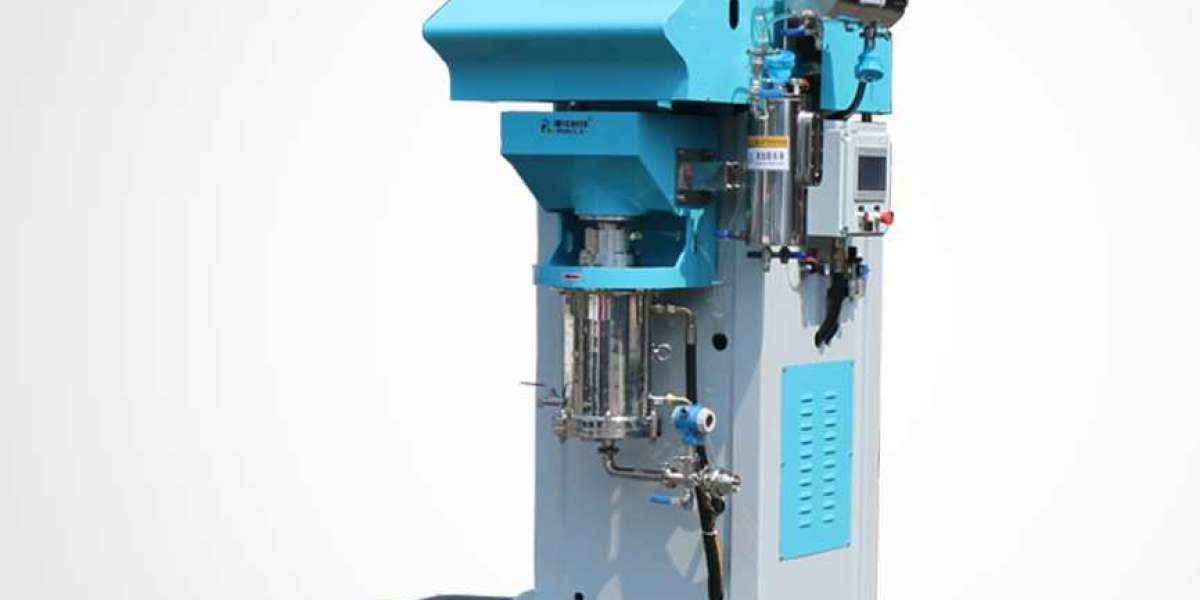

In high-performance industries such as coatings, inks, pharmaceuticals, advanced ceramics, battery materials, and nanotechnology, particle size reduction is not merely a mechanical step—it is a precision-controlled engineering process. Achieving submicron or nanometer-scale dispersion while maintaining throughput, thermal control, and operational stability requires advanced milling architecture.
The UM high energy vertical bead mill represents a next-generation solution engineered to deliver exceptional energy density, process efficiency, and intelligent automation in a compact footprint. Developed by Rucca, a manufacturer recognized for high-shear and dispersion technologies, the UM series integrates structural optimization with process intelligence, enabling manufacturers to significantly improve grinding performance while reducing spatial and energy costs.
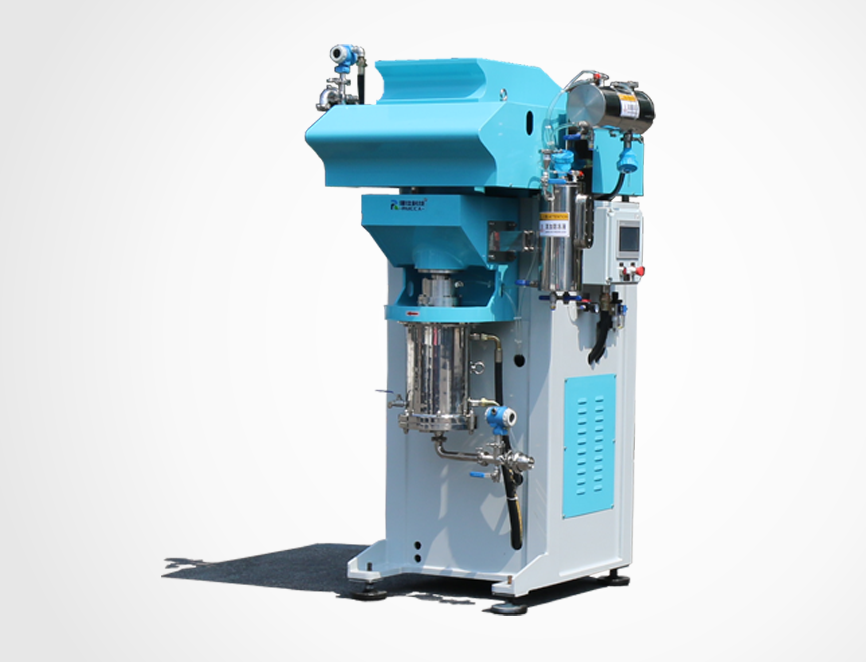
1. High Energy Density: Engineering for Maximum Impact Efficiency
At the core of the UM high energy vertical bead mill lies its high energy density milling chamber. Unlike conventional horizontal mills that rely on extended chamber length for energy transfer, the UM design concentrates energy within a vertically optimized grinding zone.
Key Engineering Advantages:
Increased bead collision frequency
Optimized shear and impact force distribution
Reduced dead zones within the chamber
Enhanced particle breakage kinetics
Higher energy density directly translates to:
Faster particle size reduction
Narrower particle size distribution (PSD)
Reduced residence time
Improved dispersion uniformity
For industries requiring ultra-fine grinding—such as lithium battery cathode materials or pigment concentrates—this energy efficiency becomes a critical competitive advantage.
2. Internal Media Recirculation: Optimized Grinding Dynamics
The UM mill incorporates an internal media recirculation system, a structural innovation that improves grinding media utilization and eliminates inefficient bead stagnation.
Why It Matters:
Traditional mills often suffer from uneven bead distribution and localized wear. The internal recirculation mechanism ensures:
Continuous redistribution of grinding media
Consistent energy transfer across the entire chamber
Lower media wear rate
Reduced contamination risk
This system enhances operational stability, particularly during long continuous production cycles, where uniform grinding performance is essential.
3. High Flow Rate Product Recirculation: Throughput Without Compromise
The UM high energy vertical bead mill is engineered for high flow rate product recirculation, allowing manufacturers to maintain production capacity while achieving fine particle size targets.
Process Benefits:
Increased material throughput
Improved heat dissipation due to dynamic circulation
Greater control over final particle size via adjustable pass cycles
Enhanced compatibility with temperature-sensitive materials
This configuration is especially advantageous in industries like pharmaceuticals and specialty chemicals, where maintaining chemical integrity during milling is non-negotiable.
4. Discrete Pass Option: Flexible Process Control
Process flexibility is increasingly important in multiproduct facilities. The UM mill features a discrete pass option, enabling operation in either continuous circulation mode or controlled single/multiple pass processing.
Application Scenarios:
Pilot-scale trials
Product changeover validation
High-value material processing
Batch-controlled precision milling
This versatility allows operators to optimize process parameters such as residence time, bead size, and rotor speed depending on the material characteristics and production objectives.
5. Full Production Size Mill in a Compact Structure
One of the most striking characteristics of the UM high energy vertical bead mill is that it is six times smaller than conventional mills with equivalent production capacity.
Engineering Implications:
Reduced plant floor space requirements
Lower infrastructure investment
Simplified installation and integration
Enhanced energy efficiency
For modern production environments where space optimization and lean manufacturing principles are prioritized, this compact design provides measurable operational value.
6. Frequency Inverter Drive: Precision Speed Control
The UM series is equipped with a frequency inverter drive, allowing precise control over rotor speed and energy input.
Operational Advantages:
Adjustable shear intensity
Energy optimization per product type
Reduced power consumption during partial loads
Soft start/stop functionality for equipment longevity
Speed modulation is particularly important for preventing over-grinding and controlling thermal rise in sensitive formulations.
7. PLC-Based Automation Package: Intelligent Milling
Automation is no longer optional in advanced manufacturing. The UM high energy vertical bead mill integrates a PLC-based automation package, delivering process transparency and control.
Automation Capabilities:
Real-time monitoring of temperature, pressure, and motor load
Programmable milling recipes
Data logging for quality traceability
Remote diagnostics compatibility
This intelligent control architecture improves repeatability, reduces operator dependency, and aligns with Industry 4.0 production frameworks.
Rucca integrates automation expertise with mechanical precision, ensuring the UM mill meets both engineering and digital manufacturing standards.
8. Industry Applications
The UM high energy vertical bead mill is widely applicable across:
Lithium battery materials (LFP, NCM, graphite)
Nano coatings and functional pigments
Printing inks and colorants
Agrochemical suspensions
Pharmaceutical suspensions
Advanced ceramics and electronic materials
Its high energy density and flexible process configuration make it suitable for both RD and full-scale industrial production.
9. Why Choose Rucca?
With decades of experience in dispersion and high-shear processing technologies, Rucca has engineered the UM high energy vertical bead mill to address real-world manufacturing challenges:
Higher efficiency with lower footprint
Intelligent automation integration
Reduced operational costs
Scalable performance from pilot to production
By combining mechanical innovation with process intelligence, Rucca delivers a solution that enhances both productivity and quality control.
Conclusion: Compact Engineering, Industrial Power
The UM high energy vertical bead mill is more than a grinding machine—it is a precision-engineered system designed to redefine efficiency, scalability, and automation in fine particle processing.
With its high energy density chamber, internal media recirculation, high flow rate product recirculation, discrete pass flexibility, compact footprint, frequency inverter drive, and PLC-based automation package, the UM mill stands as a powerful yet space-efficient solution for modern manufacturing.
In industries where particle size, dispersion stability, and operational reliability determine market success, the UM series from Rucca sets a new performance standard.